

Land
Supporting land use management for resilient landscapes.
What we do
We deliver insights on how to balance competing objectives on land. Our research addresses real-world land-use challenges, like bushfire management, land conservation, and the design and implementation of agri-environmental programs and policy.
We inform land management decisions through:
-
Economic evaluations of the environmental impacts of alternative land use options
-
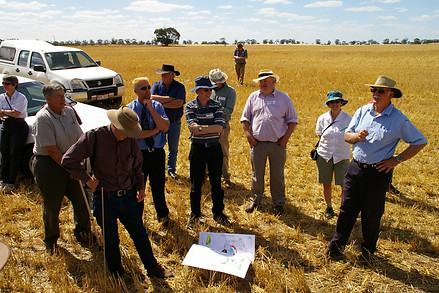
Consultations with communities and rural organisations

Our approach
Our Land research combines qualitative and quantitative methods like:
-
Benefit-cost analysis
-
Bioeconomic modelling
-
Workshop facilitation
For a detailed overview of our capabilities and examples of applications, we invite you to visit our capabilities page.

We have long-standing partnerships with government agencies, research organisations and industry bodies. Currently our partners include:
-
National Environmental Science Program (NESP) Resilient Landscapes Hub
-
WA Department of Primary Industries and Regional Development (DPIRD)
-
Australian Research Council
-
Parks Australia
-
Grower Group Alliance (GGA)
-
CSIRO
-
Grains Research and Development Corporation (GRDC)
Key Researchers

Prof David Pannell
.png)
Dr German Puga

Prof Marit Kragt
.png)
Dr Sarah Whitnall
.png)

Dr Alaya Spencer-Cotton
Industry Tools & Resources
INFFER
INFFER is a tool to apply economic analysis in environmental management. This tool was rated ‘High’ for impact and ‘High’ for approach to impact in the recent 2019 ARC assessment of research engagement and impact.
INFER enables environmental manages to undertake a process that results in the establishment of clear goals, identification of priorities and development of robust and appropriate activities and projects to protect assets.

INFFER was initially developed through the Future Farm Industries CRC funding.
Current Research

Updating the offsets calculator
Details
Funding body: NESP Resilient Landscapes Hub
Dates: 2 years (2024 - 2026)
Partnerships: Australian Department of Climate Change, Energy, the environment and Water (DCCEEW)
Project Overview
This project involved working closely with the Department of Climate Change, Energy, the Environment and Water (DCCEEW) to review and enhance the nationally significant Offset Calculator and Offsets Assessment Guide used to assess biodiversity offset proposals. Building on more than a decade of practical experience and advances in offset policy and research, the project is helping modernise the tool to improve transparency, usability and conservation outcomes, while supporting governments, industry and environmental practitioners to make more informed land management decisions.
CEEP Researchers
Prof David Pannell, A/Prof Ram Pandit, Dr Claire Doll

Featured Blogs


Body of research
We have a large body of work related to land. The following list is a selection of recently completed research projects, where you'll find a range of studies exploring various topics within our Land Theme. You are welcome to contact one of the authors to learn more.
Doll, C., Rollins, C., Burton, M., Pannell, D., Rehdanz, K., & Meyerhoff, J. (2024). Public preferences for water-conserving groundcovers on verges. Water Resources and Economics, 46, Article 100239.
Doll, C. A., Pannell, D. J., & Burton, M. P. (2024). Economic evaluation of alternative urban park designs that conserve irrigation water. Australian Journal of Agricultural and Resource Economics, 68(4), 713-730.
Doll, C., Rollins, C., Burton, M., Pannell, D., Rehdanz, K., & Meyerhoff, J. (2023). Encouraging ecological landscape designs on underutilized urban lands: Homeowner preferences for verge conversion programs. Urban Forestry and Urban Greening, 87, Article 128049.
Doll, C. A., Burton, M. P., Pannell, D. J., & Rollins, C. L. (2023). Are greenspaces too green? Landscape preferences and water use in urban parks. Ecological Economics, 211, Article 107896.
Doll, C., Polyakov, M., Pannell, D. J., & Burton, M. P. (2022). Rethinking urban park irrigation under climate change. Journal of Environmental Management, 314, Article 115012.
Rollins, C., Doll, C., Rehdanz, K., Meyerhoff, J., Burton, M., & Pannell, D. (2025). The Role of Social Norms and Economic Incentives in Encouraging the Adoption of Native Gardens. Land Economics, 101(4), 482-498.


Review of Policy approaches
Pannell, D., & Rogers, A. (2022). Agriculture and the Environment: Policy Approaches in Australia and New Zealand. Review of Environmental Economics and Policy, 16(1), 126-145.
Florec, V. (2016). Economic analysis of prescribed burning in the south-west of Western Australia. [Doctoral Thesis], The University of Western Australia].
Florec, V., Burton, M., Pannell, D., Kelso, J., & Milne, G. (2020). Where to prescribe burn: The costs and benefits of prescribed burning close to houses. International Journal of Wildland Fire, 29(5), 440-458.
Rogers, A. A., Dempster, F. L., Hawkins, J. I., Johnston, R. J., Boxall, P. C., Rolfe, J., Kragt, M. E., Burton, M. P., & Pannell, D. J. (2019). Valuing non-market economic impacts from natural hazards. Natural Hazards, 99(2), 1131-1161.